The digital landscape is constantly shifting towards something new and better. And there has been a significant growth of netizens in the world. But the real headline isn’t just about who is online; it’s what they are doing.
According to the latest 2026 mid-year global overview report by Datareportal, AI adoption has now become one of the world’s biggest online activities, with over 4 billion adults now using AI tools monthly. We are witnessing a “normalization” of technology that was barely accessible to the public three years ago.
So, in this report, we’ll take a deep dive into the biggest online activities in 2026, along with AI adoption trends, and what businesses, marketers, and creators should plan moving forward.
Nearly three-quarters of humanity is online
According to the report by Datareportal, 6.12 billion people are already accessing the internet, meaning nearly three-quarters of the global population is now active netizens. But the report also notes that although more than 2 billion people remain offline, current growth rates suggest that this number could likely fall below 2 billion within the next 12 to 18 months.
This growth is being driven largely by:
- Affordable smartphones
- Expanding mobile internet coverage
- Increased digital adoption in emerging markets ( Visit here to learn “Digital Media Buying in Myanmar, 2026”
- The rise of AI-powered platforms and tools ( Visit here to read “How AI technology is transforming Digital Marketing in Myanmar” )
For brands and businesses, this means the potential online audience is larger than ever before.
What draws people to the internet
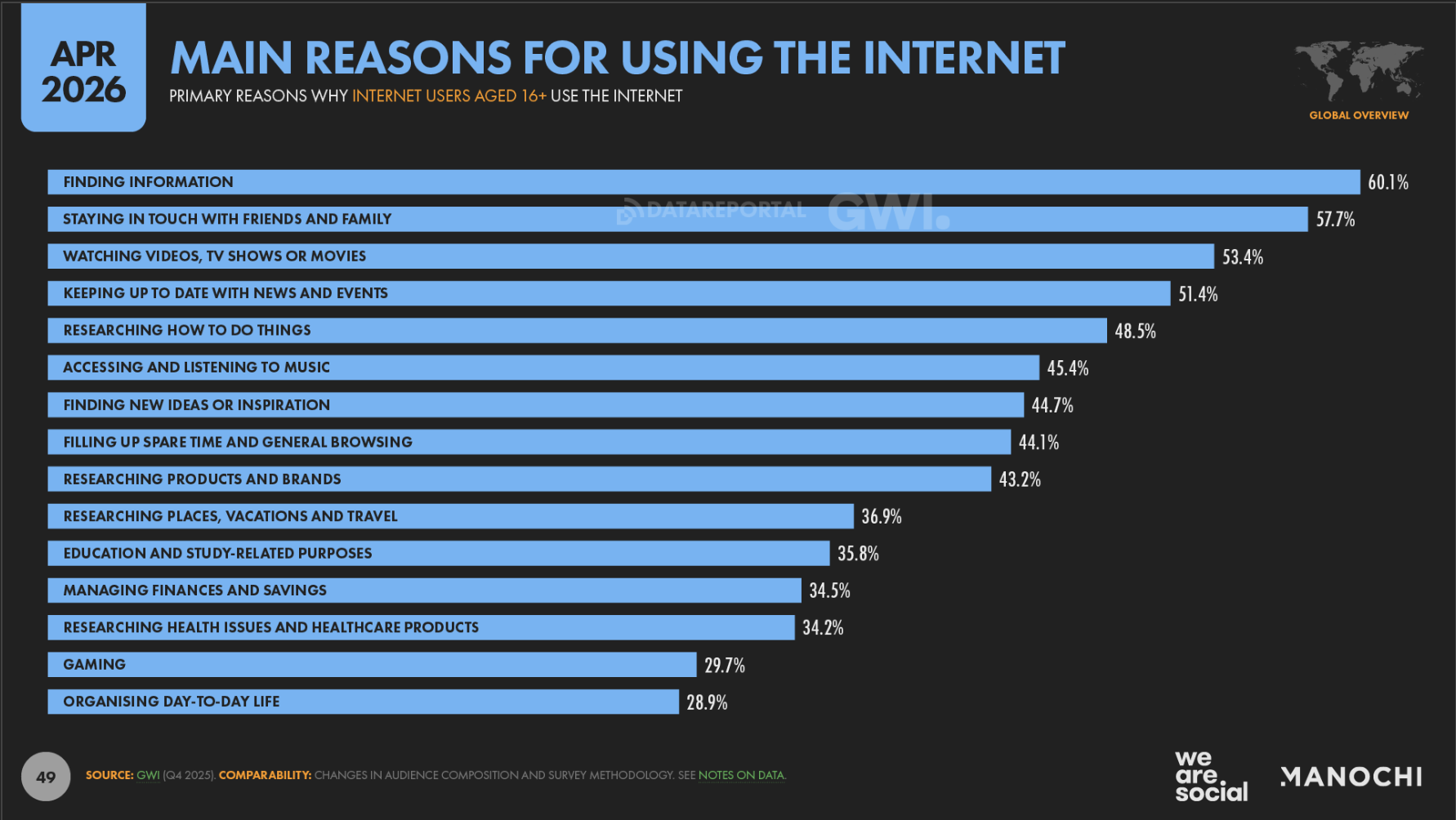
Understanding why people go online is essential for SEO, digital marketing, and content strategy. According to GWI reports, here are the top 3 motivations people use the internet in 2026.
- Finding Information
Over 60.1% of adult netizens are actively seeking information online, reflecting the broader expansion of the global digital landscape. This confirms that search intent remains one of the strongest drivers of internet behavior. What this means for SEO specialists is that informational content remains one of the best opportunities for organic traffic growth.
- Staying Connected
About 57.7% of users are on the internet to stay connected with friends, family and loved ones through messaging apps and social media networks. This trend is further supported by regional reports, such as one detailing the expanding user base of messaging apps like Messenger, Viber and Telegram in Myanmar.
- Watching Videos and Streaming
More than 53.4% of internet users watch videos, TV shows, or movies online. Short-form videos, livestreams, and AI-generated content are rapidly reshaping the entertainment industry. Platforms like YouTube, TikTok, and streaming services continue to dominate screen time globally.
Most Visited Online Platforms: Social Networks At The Top
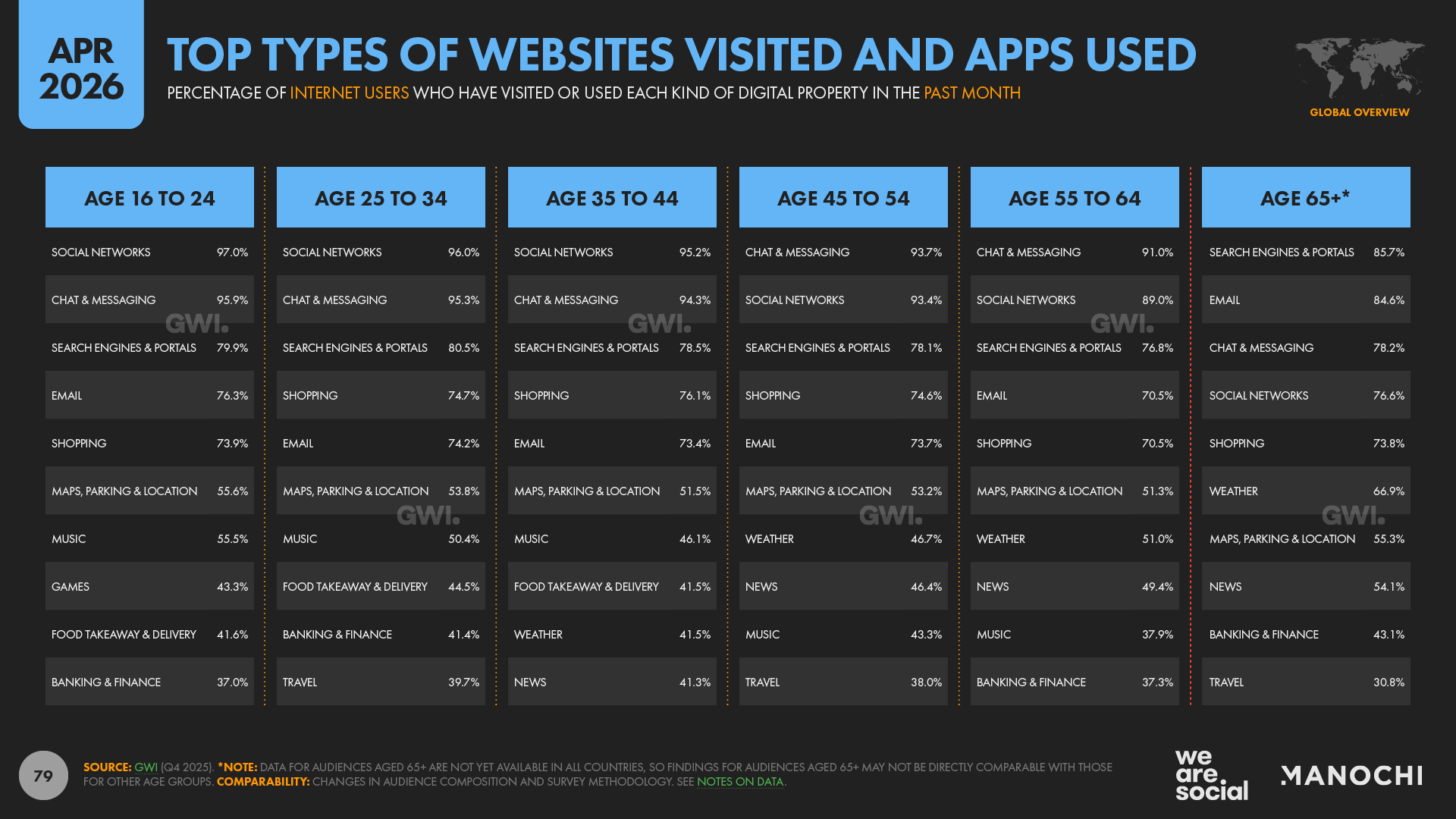
The report also reveals that social networks remain the most visited online destinations worldwide. 93.8% of the internet population are on at least one social network within the past month. Younger users aged 16 to 44 are particularly drawn to social networks, while those aged 45 to 64 show a stronger preference for chat and messaging apps, and 93.6% of online adults use platforms like WhatsApp or WeChat monthly. ( If you would like to know more detailed insights about the digital marketing channels in Myanmar, check here )
This data definitely points out that social platforms are no longer just communication tools. They are now a sanctuary of major ecosystems for shopping, entertainment, business, and AI integration.
AI Has Become an Everyday Tool
In the space of just a few years, artificial intelligence has gone from a niche curiosity to a mainstream utility.
According to GWI’s report, more than 4 in 5 (which translates to absolute numbers, that is 4.02 billion adults) now regularly use AI. This figure encompasses everything from standalone platforms like ChatGPT, Gemini, Claude, and Grok to AI features embedded in Microsoft Office, Google Workspace, Canva, and Adobe Creative Cloud.
So, why is this happening? What’s driving the rapid rise of AI in everyday digital life? Let’s take a closer look at the key data on why AI has become a routine part of online users’ daily activities.
-
ChatGPT and Generative AI Become Mainstream
The report estimates that approximately 2.42 billion people now use popular generative AI platforms such as ChatGPT, Gemini, and Claude. The growth rate is extraordinary as active generative AI users have more than doubled over the past 12 months, with global AI users increasing by over 1.4 billion between April 2025 and April 2026.
This data alone proves that generative AI is one of the fastest-growing digital technologies in history. What this means for marketers, businesses, and content creators is that we should also conform to not only for SEO & SERP rankings, but also for Generative Engine Optimization (GEO) to increase visibility and brand trust.
-
AI Now Outpaces Search Engines and Email
Perhaps the most striking statistic in this year’s data is the direct comparison between AI usage and other foundational internet activities. AI tools, at an all-time high usage of 81.2%, are now used by a larger share of online adults than search engines (79.3%), email (74.4%), and online shopping (74.2%). A technology that barely existed to the general public four years ago has already surpassed some of the most established habits in the digital world.
-
Younger Generations Primarily Driving AI Growth
Among those aged 16 to 24, roughly nine in ten use AI (at an adoption rate of 89.4%), which is the highest adoption of any age group. Usage remains very strong through ages 25 to 54, with an adoption rate of 80%+ before declining more noticeably among those 55 and above. Notably, adults over 65 represent the lowest adoption, though current data may undercount this group, as it primarily surveys those already online.
-
Asia Leads Global AI Adoption
AI adoption is far from uniform. The highest rates are concentrated across Asia, Africa, and South America, while Europe and North America fall noticeably below the global average.
The report shows:
- Kenya ranks #1 globally in AI usage at 97.5%
- UAE ranks second at 94.2%
- Indonesia ranks third at 93.6%
- China has an AI adoption rate of 86.4%
Southeast Asia overall shows an impressive 91.8% AI adoption rate among online adults. However, the United States, for instance, stands at just 71.5%, which is well below the global average.
Why People Use AI in 2026
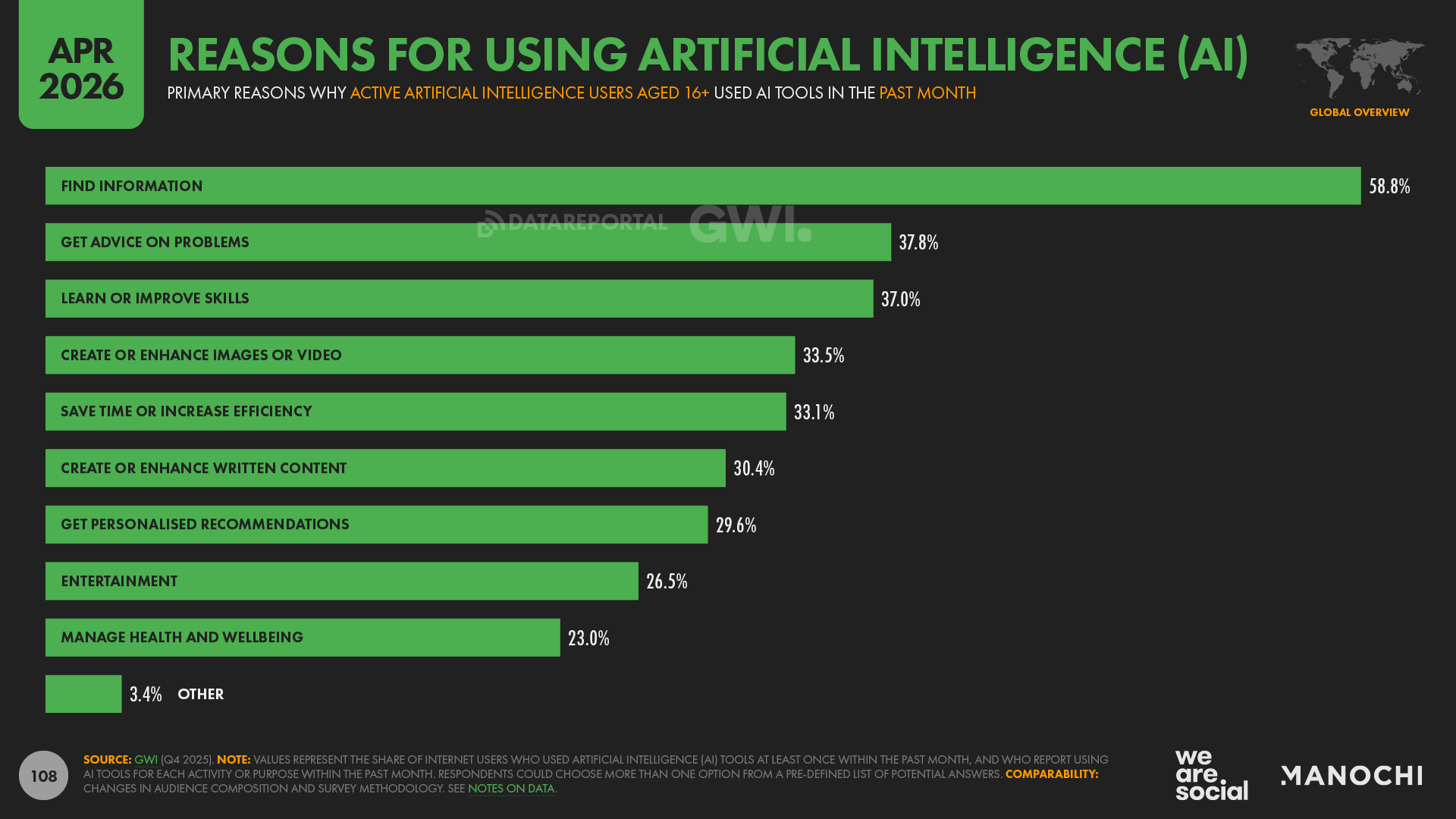
Searching for information is the single most common reason people turn to AI, cited by 58.8% of active users in GWI’s sample. This prioritization is consistent with the general internet usage data presented earlier in this report, where “Finding Information” was the top motivation, cited by 60.1% of adult netizens.
Seeking advice on problems is second at 37.8%, followed closely by learning and improving skills at 37%. A quarter of all active AI users say they use it for entertainment, a sign that these tools have already moved beyond purely practical applications. Over one billion people now use AI for entertainment despite the technology only being widely available for roughly three and a half years.
People’s Expectations vs Concerns of Using AI
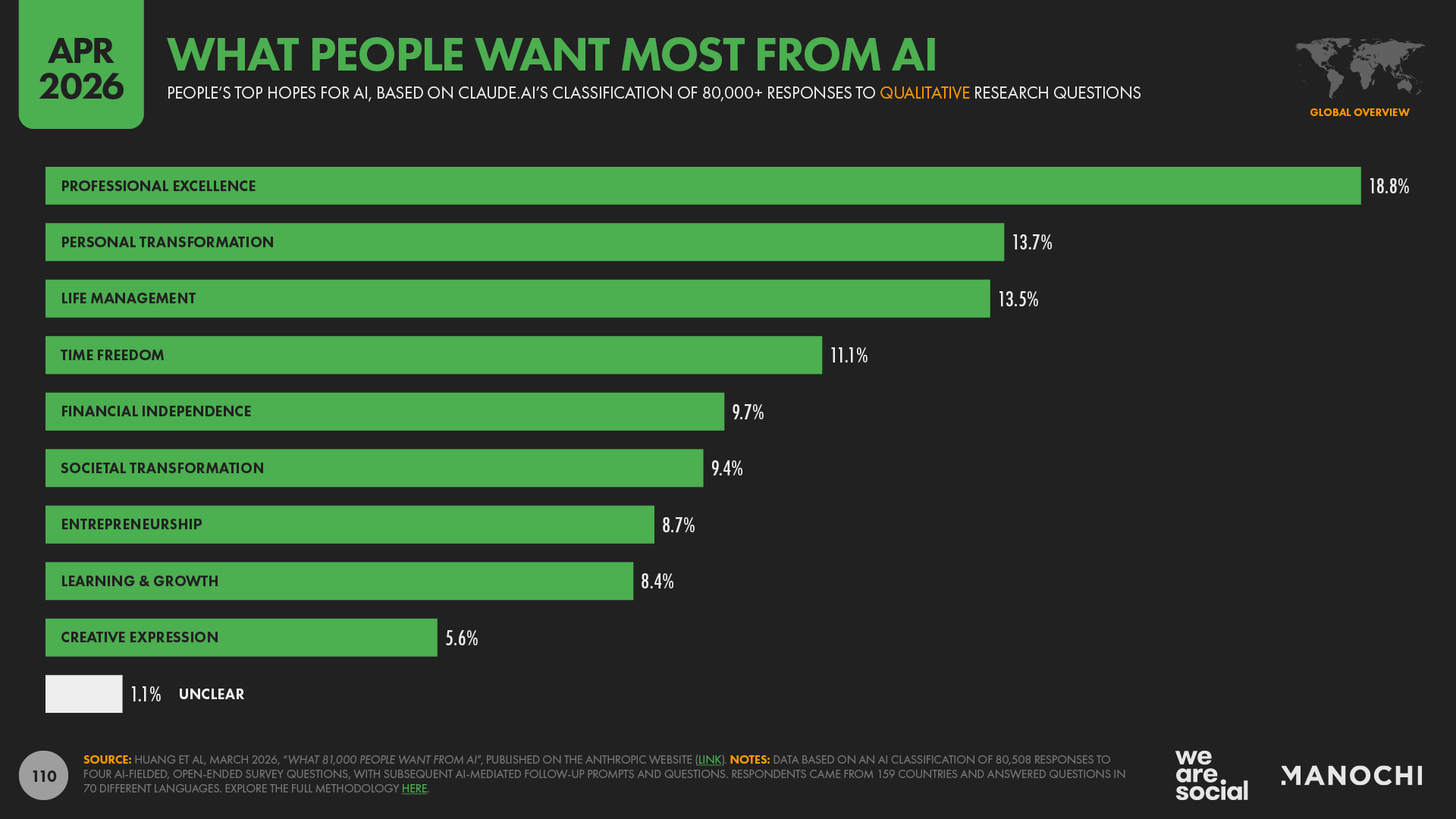
Based on an AI-assisted classification of more than 80,000 qualitative responses from 139 countries (conducted by Anthropic), we have found optimism tempered by caution. The largest share of people (18.8% response) want AI to help them achieve professional excellence, handling repetitive and time-consuming work so that they can now focus on higher-level tasks. Personal transformation (13.7%) and better life management (13.5%) follow closely.
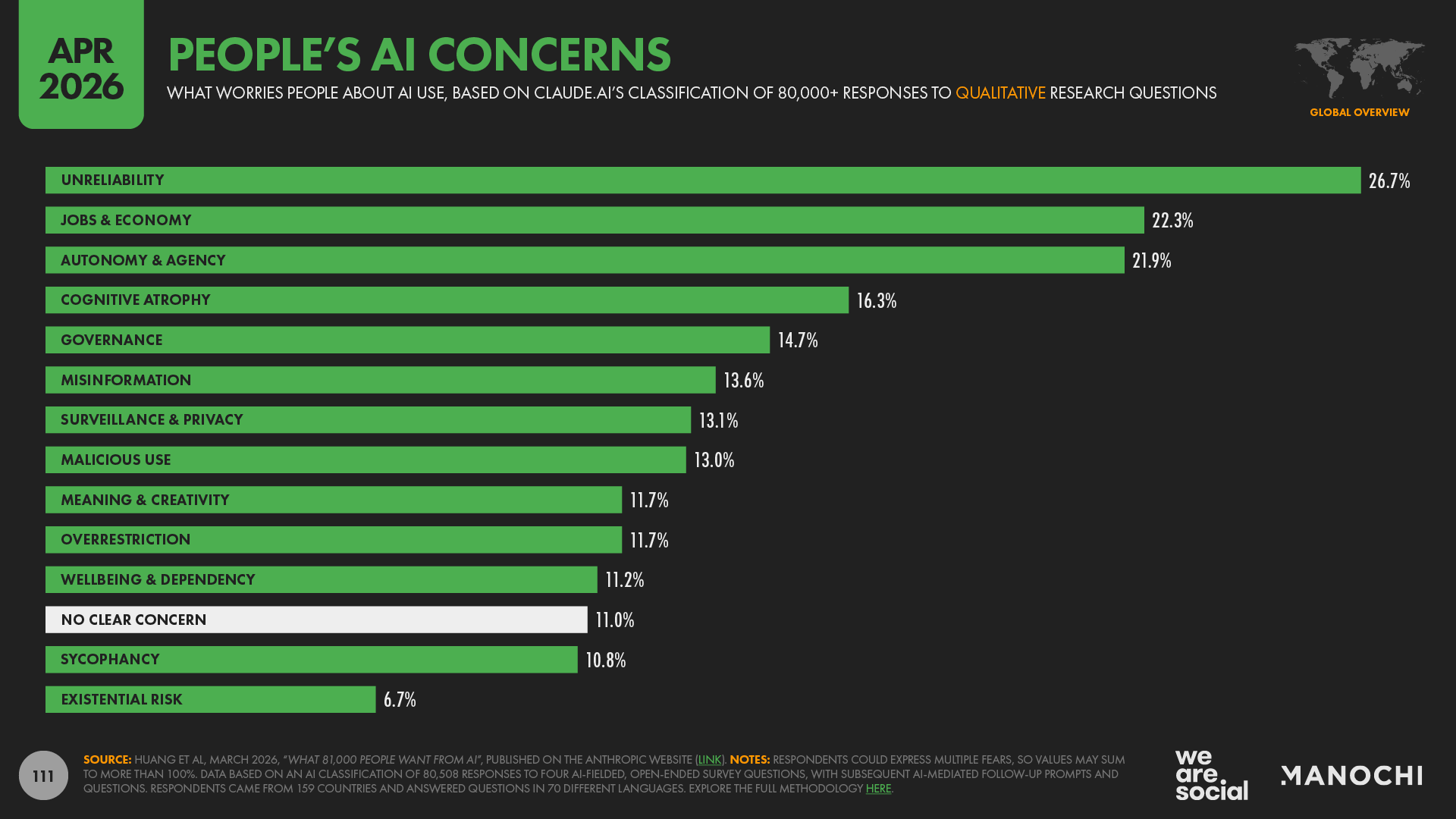
Yet concerns are substantial. Unreliability is the top fear, cited by 26.7% of respondents, reflecting anxiety about hallucinations, inaccurate answers, and fake citations. Economic anxiety runs second as 22.3% worry about job losses, unemployment, and wage inequality. Just over one in five (21.9%) fear losing autonomy, less decision-making on the human part, and becoming more dependent on systems they do not have control over.
What This Means for SEO and Digital Marketing in 2026
According to the comprehensive report by Datareportal, the rise of AI is fundamentally shaping the way we use the internet. Here are the key takeaways from the report:
-
GEO is Becoming Essential
Businesses should optimize content not only for Google search alone but also for AI-powered search tools and AI models (such as ChatGPT, Gemini, Perplexity, etc.) so that they can easily pull it into their generated answers.
-
Informational Content Still Wins
“Finding information” remains the top internet activity globally, and people also use AI for this particular reason, making educational and problem-solving content highly valuable.
-
Video and Social Content Continue to Dominate
Social media and video content (such as Instagram Reels and TikTok videos) remain central to online behavior, especially among younger audiences.
-
Asia Is a Major Growth Market
The extremely high AI adoption rate across the Asia region presents strong opportunities for digital businesses and marketers.
Final Thoughts
As the report suggests, the 2026 internet landscape shows a world rapidly shifting toward AI-driven digital behavior. With billions of people now actively using AI tools and GenAI, businesses and marketers must adapt quickly to stay competitive.
AI is no longer a gimmick or a future tech trend as it is already a core part of how people search, learn, communicate, shop, and work online every day. Brands that detect these behavioral changes and adapt early will have a significant advantage in SEO, content marketing, and digital growth throughout 2026 and beyond.